
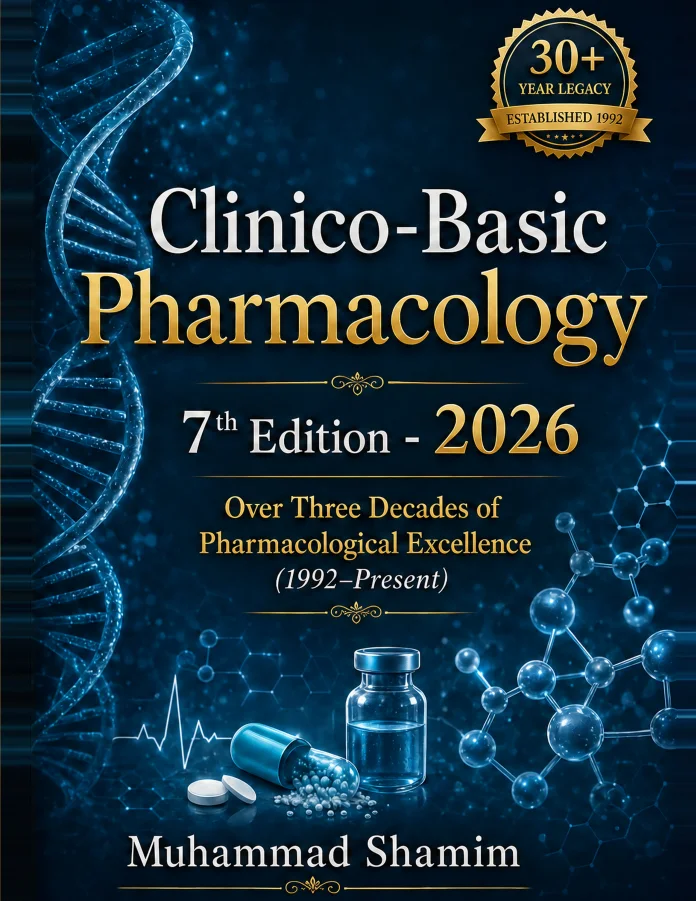
Clinico-Basic Pharmacology, 7th Edition
Comprehensive & Quick Review for Undergraduates & Postgraduates
Dr. Muhammad Shamim
A complete basic and clinical pharmacology review in one volume: twenty-five systems-based chapters, system-wise curriculum mapping for integrated and modular courses, comparison tables, OSPE with colored images, and single-best-answer self-assessment with a full answer key. For students sitting examinations and clinicians who prescribe.
- 325 pages
- English
- Print ISBN 979-8172048265
- Free to read, donations welcome
Contents
- 1. General Pharmacology
- (I) General Pharmacology
- (II) Pharmacokinetics
- (III) Pharmacodynamics
- (IV) Self Assessment
- 2. Sympathetic Nervous System Drugs
- (I) Introduction to Nervous System & Sympathetic Division
- (II) Sympathomimetics
- (III) Sympatholytics
- (IV) Self Assessment
- 3. Parasympathetic Nervous System Drugs
- (I) Introduction to Parasympathetic Nervous System
- (II) Parasympathomimetics
- (III) Parasympatholytics
- (IV) Self Assessment
- 4. Ophthalmological Drugs
- (I) Ophthalmological Drugs
- (II) Self Assessment
- 5. Central Nervous System Drugs
- (I) Sedative-Hypnotics
- (II) Alcohols
- (III) Anti-Epileptic Drugs
- (IV) Anti-Parkinsonian Drugs
- (V) Anti-Psychotic Drugs
- (VI) Anti-Manic Drugs
- (VII) Anti-Depressant Drugs
- (VIII) CNS Stimulants
- (IX) Anti-Migraine Drugs
- (X) Self Assessment
- 6. Anesthetics
- (I) General Anesthetics
- (II) Local Anesthetics
- (III) Self Assessment
- 7. Skeletal Muscle Relaxants
- (I) Skeletal Muscle Relaxants
- (II) Spasmolytics & Direct Relaxants
- (III) Self Assessment
- 8. Opioid Analgesics & Antagonists
- (I) Opioid Analgesics
- (II) Opioid Antagonists
- (III) Self Assessment
- 9. NSAIDs, Nonopioid Analgesics, DMARDs & Anti-Gout Drugs
- (I) NSAIDs
- (II) Non-Opioid Analgesics
- (III) DMARDs
- (IV) Anti-Gout Drugs
- (V) Self Assessment
- 10. Drugs Affecting Blood
- (I) Anti-Anemics
- (II) Anti-Coagulants
- (III) Coagulants
- (IV) Other Hematologic Drugs
- (V) Drugs Causing Blood Disorders
- (VI) Self Assessment
- 11. Cardiovascular System Drugs
- (I) Anti-Hypertensive Drugs
- (II) Anti-Anginal Drugs
- (III) Drug Treatment of CCF
- (IV) Drug Treatment of Cardiac Arrhythmias
- (V) Self Assessment
- 12. Renal Drugs
- (I) Diuretics
- (II) Other Renal Drugs
- (III) Drug-Induced Renal Diseases
- (IV) Drug Selection in Renal Disease
- (V) Self Assessment
- 13. Drugs Affecting Respiratory System
- (I) Anti-Asthmatics
- (II) Respiratory Stimulants
- (III) Anti-Tussives
- (IV) Self Assessment
- 14. Gastrointestinal Drugs
- (I) Anti-Peptic Ulcer Drugs
- (II) Anti-Emetics
- (III) Anti-Diarrheals
- (IV) Laxatives
- (V) Miscellaneous GIT Drugs
- (VI) Self Assessment
- 15. Hepato-Pancreatico-Biliary Drugs
- (I) Liver & Drugs
- (II) Biliary & Pancreatic Drugs
- (III) Self Assessment
- 16. Autacoids & its Antagonists
- (I) Histamine & its Antagonists
- (II) Serotonin & its Antagonists
- (III) Eicosanoids
- (IV) Self Assessment
- 17. Endocrine Drugs
- (I) Hypothalamic & Pituitary Hormones
- (II) Thyroid & Anti-Thyroid Drugs
- (III) Anti-Diabetic Drugs
- (IV) Adrenocorticosteroids & Analogues
- (V) Gonadal Hormones & Analogues
- (VI) Self Assessment
- 18. Chemotherapy of Bacterial Infections
- (I) Introduction
- (II) Penicillins
- (III) Cephalosporins
- (IV) Chloramphenicol, Macrolides & Clindamycin
- (V) Tetracyclines
- (VI) Aminoglycosides
- (VII) Sulfonamides
- (VIII) Trimethoprim & Co-Trimoxazole
- (IX) Fluoroquinolones
- (X) Anti-Tuberculous Drugs
- (XI) Anti-Leprotic Drugs
- (XII) Drug Treatment of UTI
- (XIII) Self Assessment
- 19. Chemotherapy of Fungal Infections
- (I) Anti-Fungal Agents
- (II) Self Assessment
- 20. Chemotherapy of Viral Infections
- (I) Anti-Virals
- (II) Self Assessment
- 21. Chemotherapy of Protozoal Infections
- (I) Drug Treatment of Malaria
- (II) Drug Treatment of Amebiasis
- (III) Drug Treatment of Leishmaniasis
- (IV) Drug Treatment of Trypanosomiasis
- (V) Self Assessment
- 22. Chemotherapy of Helmintic Infections
- (I) Drug Treatment of Schistosomiasis
- (II) Drug Treatment of Tapeworm Infestations
- (III) Drug Treatment of Roundworm Infestations
- (IV) Self Assessment
- 23. Cancer Chemotherapy
- (I) Anti-Cancer Drugs
- (II) Self Assessment
- 24. Vitamins & Minerals
- (I) Vitamins
- (II) Minerals
- (III) Self Assessment
- 25. Fluids & Electrolytes
- (I) Body Fluids & Electrolytes Balance
- (II) Intravenous Fluids
- (III) Electrolytes
- (IV) Self Assessment
- 26. Drug Interactions
- 27. Antidotes
- 28. Comparative Pharmacology
- (I) Physostigmine & Neostigmine
- (II) Tubocurarine & Suxamethonium
- (III) Morphine & Codeine
- (IV) Chlorpromazine & Meprobamate
- (V) Cocaine & Procaine
- (VI) Guanethidine & Reserpine
- (VII) Digoxin & Digitoxin
- (VIII) ACTH & Corticosteroids
- (IX) Halothane & Ether
- (X) Opioid & Non-opioid Analgesics
- (XI) Codeine & Aspirin
- (XII) Quinidine & Digitalis
- (XIII) Atropine & Hyoscine (Scopolamine)
- (XIV) Epinephrine & Norepinephrine
- (XV) Ergotamine & Ergometrine
- (XVI) Morphine & Meperidine (Pethidine)
- (XVII) Heparin & Warfarin
- (XVIII) Metformin & Sulfonylureas
- (XIX) Unfractionated Heparin (UFH) & LMWH
- (XX) Morphine & Fentanyl
- (XXI) Diazepam & Midazolam
- (XXII) Atenolol & Carvedilol
- 29. Practical Pharmacology
- (I) Pharmacy
- (II) Experimental Pharmacology
- (III) Clinical Pharmacology Practicals
- (IV) OSPE in Pharmacology
- 30. True / False Type MCQs
- 31. One-Best Type MCQs
- 32. Answers of Self-Assessment Questions
- 33. Alphabetical Index
A course on AI in clinical practice, for physicians
Prompt Medicine™ teaches physicians how to think with AI, where its limits lie, and how to stay fully accountable for patient care. The Foundation Module runs to six units, thirty video lectures and about four hours, with a certificate on completion.
Free for students and trainees of Dr. Shamim’s institutions
- Baqai Medical University
- Dow Medical College
- Civil Hospital Karachi
- Prince Sattam Bin Abdulaziz University
- College of Physicians & Surgeons Pakistan
Email your referral letter from your principal, dean or training supervisor to drshamim.ksa@gmail.com, with your institution and year of study. Complimentary enrolment is arranged by hand.