
Library
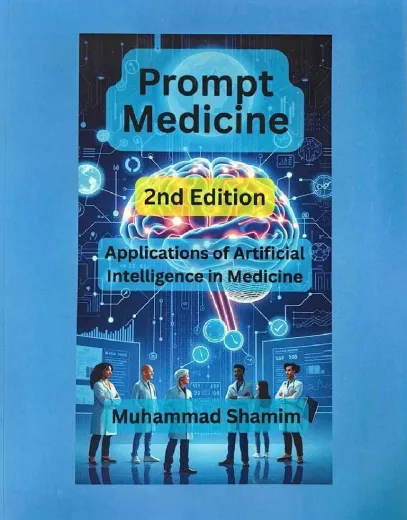
Prompt Medicine, 2nd Edition
Applications of Artificial Intelligence in Medicine
Dr. Muhammad Shamim
This is an earlier edition, kept here free to read.
A guide to the art and science of artificial intelligence in medicine, for medical students, faculty and healthcare managers. Covers knowledge and skills across the specialties, patient management, research and medical writing, teaching, hospital management and drug discovery. The fully rewritten 3rd edition is available in print and Kindle on Amazon.
- 237 pages
- English
- Free to read
Contents
- Preface to the Second Edition
- Overview of Prompt Medicine: Second Edition
- Unit 1: Knowledge and Skills
- 1.1 Anatomy
- 1.2 Physiology
- 1.3 Pathology
- 1.4 Biochemistry
- 1.5 Microbiology
- 1.6 Pharmacology and in Drug Discovery
- 1.7 Immunology
- 1.8 Genetics and Genomics
- 1.9 Internal Medicine
- 1.10 Surgery
- 1.11 Pediatriacs
- 1.12 Obstetrics and Gynecology
- 1.13 Ophthalmology
- 1.14 Otolaryngology (ENT)
- Unit 2: Patient Management
- 2.1 Internal Medicine
- 2.2 Surgery
- 2.3 Pediatrics
- 2.4 Obstetrics and Gynecology
- 2.5 Psychiatry
- 2.6 Neurology
- 2.7 Dermatology
- 2.8 Ophthalmology
- 2.9 Otolaryngology (ENT)
- 2.10 Radiology
- 2.11 Orthopedics
- 2.12 Urology
- 2.13 Cardiology
- 2.14 Nephrology
- 2.15 Plastic Surgery
- Unit 3: Research and Medical Writing
- 3.1 Conceptualizing Research Questions
- 3.2 Literature Review and Data Synthesis
- 3.3 Statistical Analysis and Data Interpretation
- 3.4 Medical Writing and Editing
- 3.5 Citation Management and Referencing
- 3.6 Ethical Considerations in AI-Enhanced Research
- 3.7 Evidence-Based Medicine
- Unit 4: Teaching of Undergraduates & Postgraduates in Medicine
- 4.1 Foundations of Modern Medical Education
- 4.2 Curriculum Design and Planning with AI
- 4.3 Technology Integration and Active Learning
- 4.4 Effective Teaching Methodologies
- 4.5 Practical and Clinical Teaching
- 4.6 Assessment Strategies and Tools
- 4.7 Professional Development and Mentorship
- Unit 5: Hospital Management - Updated Content
- 5.1 Data-Driven Decision-Making
- 5.2 Clinical Workflow Optimization
- 5.3 Personalized Patient Care
- 5.4 Revenue Cycle Management
- 5.5 Health Information Security
- 5.6 Operational Efficiency and Resource Allocation
- 5.7 Virtual Health Assistants and Telehealth
- 5.8 Quality Assurance and Compliance
- 5.9 Natural Language Processing in Communication
- 5.10 Innovations in Healthcare Research
- Unit 6: AI in Drugh Discovery and Development
- 6.1 Introduction to AI in Drug Discovery
- 6.2 The Evolution of AI in Drug Discovery
- 6.3 Key AI Technologies in Drug Discovery
- 6.4 Case Studies and Breakthroughs
- 6.5 Practical Applications for Medical Professionals
- 6.6 Future Directions and Emerging Trends
- 6.7 Ethical and Regulatory Considerations
- Unit 7: Emerging AI Technologies in Medicine
- 7.1 The Evolution of AI Platforms for Medical Professionals (2023-2025)
- 7.2 Overview of Prominent AI Platforms (2025)
- 7.3 Comparative Analysis for Medical Applications
- 7.4 Practical Implementation Strategies
- 7.5 Ethical Considerations and Best Practices
- 7.6 Future Directions and Emerging Platforms
- 7.7 Practical Exercises and Case Studies
- 7.8 Conclusion
- References